Zapotec Civilization: A History from Beginning to End (Mesoamerican History Book 2) by Hourly History
Author:Hourly History [History, Hourly]
Language: eng
Format: epub
Published: 2019-07-22T00:00:00+00:00
Chapter Six
Zapotec Religion and Society
âMy father told me that women were only good for making tortillas and having babies.â
âEufrosina Cruz Mendoza, Zapotec politician
Archaeological excavations suggest that religion was a major factor in the lives of the Zapotecs, combined with veneration of the dead and mythology about the afterlife.
It seems that Zapotec religion was extremely complex, and was to some extent based on the beliefs of the Zapotecsâ predecessors, the Olmecs. The Zapotec perception of the universe was of three separate but interconnected realmsâthe House of Earth (with Monte Albán at its heart) with the House of the Sky above and the House of the Underworld below. Some scholars claim that the Zapotec had no word equivalent to âreligion,â suggesting that religious ceremony and belief were so ingrained that they were considered part of everyday life and not as something separate or different.
There are a number of different Zapotec origin tales. In one version, the Zapotec were the first humans in the Oaxaca Valley and were created from rocks there (or somehow descended from animals such as the puma or the ocelot). In another version, the Zapotec rulers were directly descended from a race of people who lived in the Sky Realm. When these rulers died, they returned to this land above the cloudsâthis is said to be the reason for the Zapotec being called the Cloud People.
Like most Mesoamerican religions, the Zapotec believed in something they called pee, the life force. This force (also sometimes called the breath of life) existed in all living things, though the Zapotec seem to have extended this to include, for example, clouds and lightning. This has led some historians to claim that the Zapotec were animistic (attributing life to events or objects), though this may actually simply be a different interpretation of what is and is not alive. Pee force was represented by deities and was considered part of what maintained order in the universe. If the balance of the universe was disrupted, this was believed to cause bad weather, drought, and other natural disasters. Many Zapotec religious rituals are concerned with ensuring that this cosmic order was maintained.
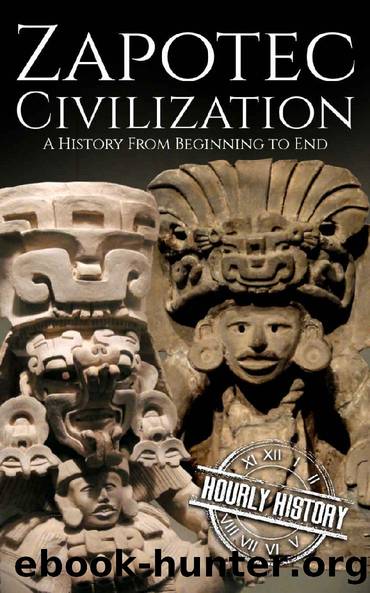
The Zapotec appear to have been polytheistic, worshipping a bewildering array of different deities. Many of these were male (for example, Cocijo, god of lightning and rain, and Pitao Cozobi, god of maize) though some were female (for example, Huichaana, goddess of childbirth, and Xonaxi Quecuya, goddess of death). Several of these gods were married, and the Zapotec kept careful records of the relationships between gods and of any children. Many Zapotec sculptures, carvings, and decorations feature representations of these deities, recognizable by their different attireâmale deities wear breechclouts while females wear skirts.
Most historians suggest that Zapotec religion was overseen and administered by two distinct classes of priests. The high priests (or temple priests) lived in or around large temples and were responsible for maintaining the sacred calendar and for overseeing important ceremonies. High priests were probably high-status members of Zapotec society and lived with the ruling class and the military elite.
Download
This site does not store any files on its server. We only index and link to content provided by other sites. Please contact the content providers to delete copyright contents if any and email us, we'll remove relevant links or contents immediately.
| Africa | Americas |
| Arctic & Antarctica | Asia |
| Australia & Oceania | Europe |
| Middle East | Russia |
| United States | World |
| Ancient Civilizations | Military |
| Historical Study & Educational Resources |
The Dawn of Everything by David Graeber & David Wengrow(1707)
The Bomber Mafia by Malcolm Gladwell(1622)
Facing the Mountain by Daniel James Brown(1553)
Submerged Prehistory by Benjamin Jonathan; & Clive Bonsall & Catriona Pickard & Anders Fischer(1455)
Wandering in Strange Lands by Morgan Jerkins(1430)
Tip Top by Bill James(1416)
Driving While Brown: Sheriff Joe Arpaio Versus the Latino Resistance by Terry Greene Sterling & Jude Joffe-Block(1376)
Red Roulette : An Insider's Story of Wealth, Power, Corruption, and Vengeance in Today's China (9781982156176) by Shum Desmond(1359)
Evil Geniuses: The Unmaking of America: A Recent History by Kurt Andersen(1353)
The Way of Fire and Ice: The Living Tradition of Norse Paganism by Ryan Smith(1336)
American Kompromat by Craig Unger(1315)
F*cking History by The Captain(1304)
It Was All a Lie by Stuart Stevens;(1300)
American Dreams by Unknown(1286)
Treasure Islands: Tax Havens and the Men who Stole the World by Nicholas Shaxson(1273)
Evil Geniuses by Kurt Andersen(1257)
White House Inc. by Dan Alexander(1212)
The First Conspiracy by Brad Meltzer & Josh Mensch(1174)
The Fifteen Biggest Lies about the Economy: And Everything Else the Right Doesn't Want You to Know about Taxes, Jobs, and Corporate America by Joshua Holland(1126)
